Earthing Maintenance
To ensure safety and effective performance, earthing systems should be regularly maintained.
Earthing Maintenance
1. Visual Inspection
- Check earth pits for any damage, cracks, or waterlogging.
- Ensure the earth electrodes, conductors, and joints are free from corrosion.
- Verify that earthing connections are tight and intact.
- Ensure covers, chamber lids, and identification marks are present.
Soil and Compound Condition
- Verify that the earthing pit is filled with charcoal, bentonite, or earth-enhancing compounds as per design.
- Maintain required moisture in the pit (pour water periodically in dry seasons).
- Avoid salt if it accelerates corrosion in metallic parts.
Earthing Conductors & Strips
- Check for rust, mechanical damage, or loose joints.
- Ensure mechanical protection (like GI pipe, PVC covering) where needed.
Periodic Watering
- In dry soil conditions, add water regularly to maintain low resistance.
Earthing Testing
Testing ensures the system provides a safe path for fault current.
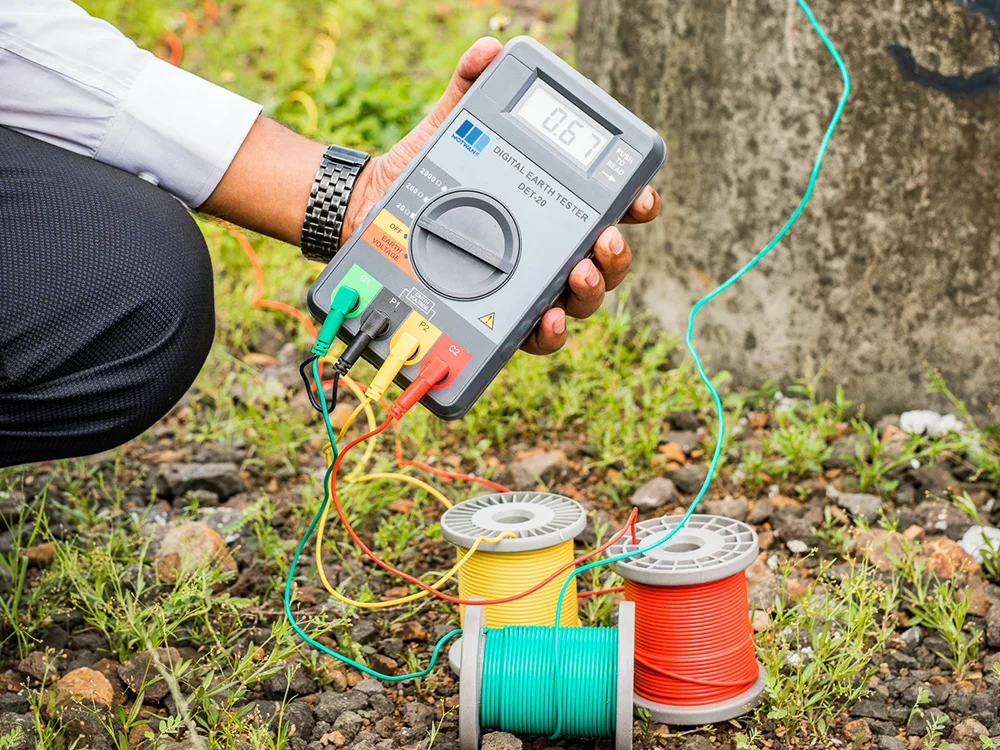
Earth Resistance Test (Fall-of-Potential Method)
Measure the resistance of earth electrode using an Earth Tester / Megger.
- Power stations / substations → ≤ 1 ohm
- Industrial premises → ≤ 2 ohms
- Commercial / Residential buildings → ≤ 5 ohms
Clamp-on Earth Tester
- Used without disconnecting the earthing system.
- Measures resistance of electrode directly by clamping on the conductor.
Continuity Test
- Ensures the earthing conductor is continuous and connected properly.
- Performed using an ohmmeter or multimeter.
Soil Resistivity Test (Wenner’s Method)
- Measures soil resistivity to check if additional electrodes or chemical compounds are required.
Maintenance Schedule
- Monthly → Visual inspection, watering (if required).
- Quarterly → Tightening connections, checking corrosion.
- Yearly → Earth resistance measurement, soil resistivity test.
Proper maintenance and testing of earthing ensures safety against electric shock, fire hazards, and equipment damage.